

Hi there,
Before we start, a friendly reminder that on October 7th, I am co-hosting a salon with Jan Planit, Deborah Perry Piscione and Jeanmarie Macari LaBonte to explore the future of work, and how we might thoughtfully invest our time and our capital in the era of AI and humanoids, and what it means for the world we are leaving to the next generation. At the time I finished this newsletter, we only had 2 more tickets available, so if you are interested, please run to get them:
Tickets sold HERE
Date: Wednesday, October 7th
Time: From 6pm to 8pmLocation: Hamptons private residence, address provided upon confirmation


Now on to our regular programming
Hi there,
A few years ago, I got a call from my daughter’s school. There has been an incident with a group of girls, and my daughter was crying and in distress. I was later told that she was called a snitch, then accosted and intimidated by a group of girls, and bullied by a few.
Someone at school had been vaping, and a rumor started that my daughter was the one who told ME, and then I told the director. She hadn’t. I didn’t. But once the word was out, she was made to feel she and I had done something shameful.
I was baffled: so someone was breaking the rules, and the person being punished was the one suspected of naming it, not the one doing it???
That is how groups become mobs. Punishing the “snitch” is a message to everyone else who is watching: this is what happens if you speak. Stay quiet and loyal, and you nothing will happen to you.
I have been thinking about this idea a lot this week because of the Cornell 7. There are so many layers of cultural issues and misogyny that we could discuss about this case (though honestly I don’t even know what else to say when the language exchanged between students include “Shop Still open?”).
But today I want to focus on snitchers, whistleblowers, witnesses and bystanders because we may not be able to control how people like these students may treat women, but we can control how we show up in the world, and how we raise our own children.
THE GROUP CHAT
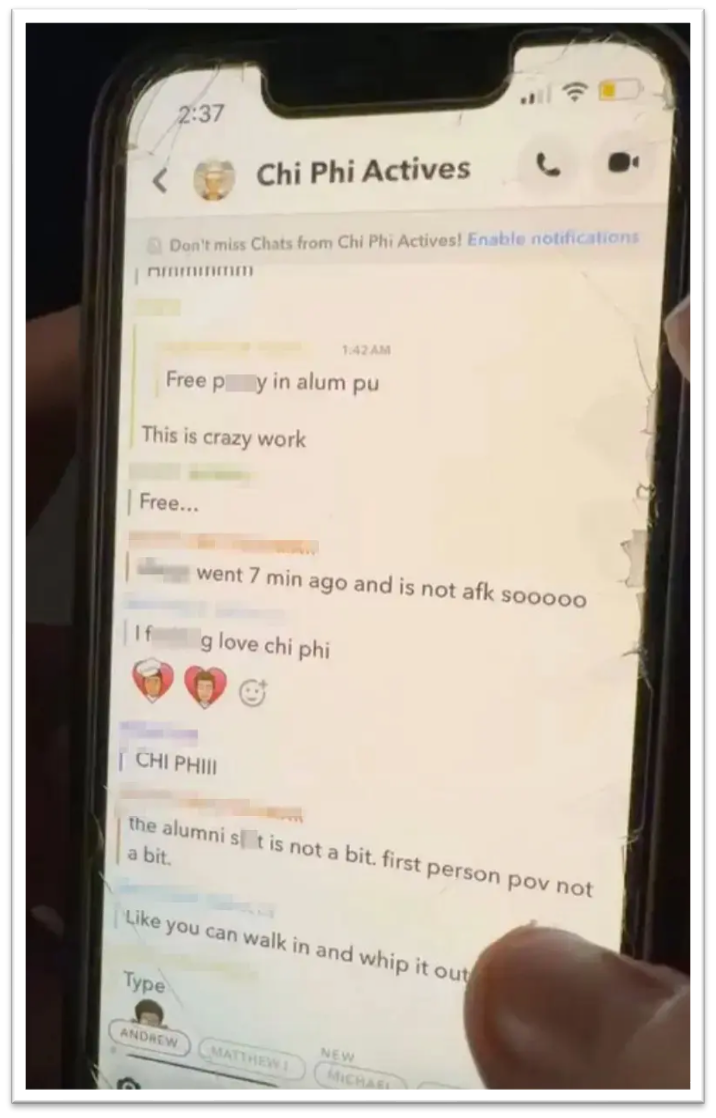
By now you probably know the case of the Cornell 7. A former Cornell student has filed a lawsuit alleging that in October 2024, when she was 20, she was pressured into taking ketamine at the Chi Phi fraternity house and then sexually assaulted by 7 members over several hours. According to the lawsuit, at 1:42 a.m. a member messaged the fraternity’s Snapchat group “free p*ssy”. Later in the chat: “Shop still open?” The reply: “Yea.” I read that there were 57 people in this group chat.
The local district attorney declined to prosecute in 2024. After the lawsuit and a wave of public outrage, his office has reopened the case and says it will bring evidence to a grand jury, and New York’s attorney general is reviewing how Cornell handled it. Cornell says two students were expelled, two were suspended, and the chapter was closed. The men deny the accusations, and nothing has yet been proven in court.
I keep coming back to that group chat. A message went out to a group of young men. And from everything reported so far, not one picked up the phone. Not one knocked on that door to interfere, or to say stop. Not one from 57 of them.
SNITCHING OR WHISTLEBLOWING?

If one of the 57 young men in that chat had been willing to be called a snitch that night, she might have been spared, at best, public humiliation, and at worst, rape.
So where is the line? When does telling mean “snitching,” and when does it become whistleblowing — or just being a decent human being???
I think the difference is this: snitching, the way we use the word, is about betraying the group for personal gain. Whistleblowing is about exposing wrongdoing to protect the people being harmed. The culture of “don’t snitch” asks “whose side are you on?”. Whistleblowing asks a better one: “who is getting hurt and who is doing the hurting?”, and “what am I going to do about it”?
And what is the difference between a witness and a bystander when both see and both know? A bystander decides it isn’t their business, and a witness decides it is. A witness understands that seeing something creates a responsibility to act, to speak, to call for help, to testify later if that is what it takes.
Everyone in that group chat was, at the very least, a witness to something. And, as far as we know, every one of them chose to be a bystander.
I personally believe she was raped, though the case has not yet been proven in court. But even if it never is, this much is true: if one of the 57 young men in that chat had been willing to be called a snitch that night, she might have been spared, at best, public humiliation, and at worst, rape.
SHAME, MISPLACED

In the story we tell about snitches, the person who speaks up becomes the problem. The girl who reports becomes “drama.” The kid who tells the principal becomes the traitor. Meanwhile the person who did the harm fades into the background, protected by everyone’s silence.
We do this to victims, too. We ask what she was drinking, why she went upstairs, why she waited to report. We rarely ask the other questions with the same energy: Why did they think they could? Why did no one stop them? Why did they think it was OK to begin with?
When a culture normalizes bullying and intimidation, silence is the obvious and expected outcome. Why are we shocked nobody in that group chat said anything? Most of them had probably been learning since middle school exactly what happens to the one who does.
HOW WE RAISE THEM
This is where we, as parents and caregivers, have real power.
We need to raise our children — all of them, not only our boys — to know the difference between tattling on a classmate for chewing gum and speaking up when someone is being hurt. And we need to tell them that it’s okay to be called a snitch.
Be called a snitch if it means a girl is not raped.
Be called a snitch if it means a boy is protected from physical abuse.
Be called a snitch if it means a child is spared from bullying.
This is what I want my children to carry with them:
✷ Your first loyalty is to yourself and to the person being hurt, not to the group, especially when the price of admission is your silence.
✷ You don’t need to be certain. “Something doesn’t feel right” is enough to get an adult or call for help. You don’t accuse anyone if you aren’t certain, but you can follow your instincts to try to protect someone else.
✷ Telling to get someone in trouble is different from telling to get someone out of danger.
✷ Speaking up and helping someone can be quiet: a text to a parent, an anonymous report, a call to 911, walking a friend out of the room.
✷ If people turn on you for it, that says something about them, not you. You will make new (and better) friends.
✷ Learning to take accountability for your own actions at home will teach you how to do the same in the real world, and you won’t feel the need to bully others into lying or hiding anything on your behalf.
And we have to model it ourselves at work, in our friendships, in the group chats we are part of as adults. Children are watching and learning from what we do, not from what we say.
CHANGING THE CULTURE CAN START AT HOME
I am disheartened and angry. I want justice for this young woman, and I want every institution involved to answer for how her case was handled.
There are so many layers to this problem, and we often feel to powerless in the face of injustice. But we can change things within our grasp, starting at home. Words like “snitch” only hold power because we leave them unexamined. Every time we talk about this at dinner, in the car, with our kids, and with each other we loosen their grip a little. We change the culture a little. We make it a little easier for the next person, in the next group chat, to be a witness instead of a bystander, and to be the one who says stop.
I would rather my children be called snitches a hundred times than be bystanders once.
Sending love,
Patricia
If you or someone you love has been affected by sexual violence, RAINN’s National Sexual Assault Hotline is available 24/7 at 1-800-656-4673 or online.rainn.org.